George William Stone EMPTAGE
George’s life and death has triggered many questions.
- Who was George William Stone EMPTAGE?
- Why is George listed Twice on the 1891 Census?
- Were his parents married Twice? And why possibly 8 years after he was born?
- Why do newspapers and websites state George was Imbecilic, and was it True?
- Why is George not on a Milton Regis Memorial?
Who was George William Stone EMPTAGE?:
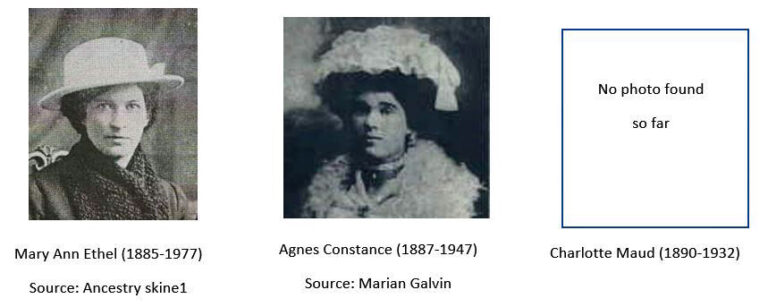
George was born on the 28th of April 1884 at 5 Chalkwell Road, Milton Regis, Kent. He was the eldest of four children and the only son of George Emptage, a mariner and barge captain, and his wife Charlotte Victoria nee Stone-Greensted. He had three sisters named Mary, Agnes and Charlotte, and they were married in 1905, 1908 and 1906, to Edward J Swan (1881-1955), John Galvin (1874-1938) and Henry Valentine Jarvis (1878-1946).
Why is George listed Twice on the 1891 Census?
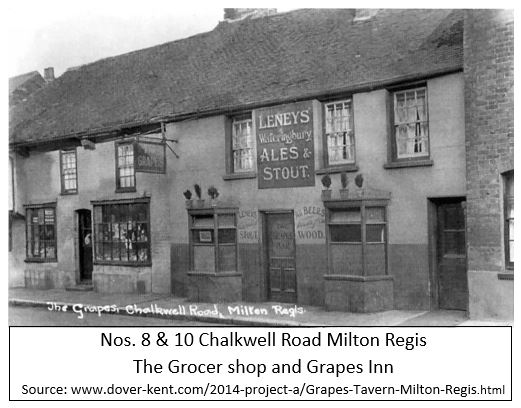
In 1891 the census shows George living with his parents and sisters at 9, Chalkwell Road Milton Regis. George was listed as aged 6, a scholar. Strangely on the same night George is also listed at 5, Chalkwell Road, living with his maternal grandmother, Mary Ann Greensted, who was the shopkeeper (at No 8, Chalkwell Road), and wife of the landlord William Stone, at the Grapes Inn (at No 10, Chalkwell Road). Here George is listed as aged 7, and Mary’s ‘grandson’. His grandfather, who George is named after had died in 1881, before he was born. His grandmother died in 1899, registered at 8, Chalkwell Road.
It is likely that George stayed with his maternal grandmother, so she listed him, and his parents also wanted to list him, even if he wasn’t there that night, to keep the record of the family whole.
Why were his parents married Twice? Or possibly 8 years after he was born?
The 1911 census clearly records that George’s parents George and Charlotte had been married 19 years, thus married in 1892:
And yet we also have this record that show George and Charlotte were married in January 1884 (the year George was born):
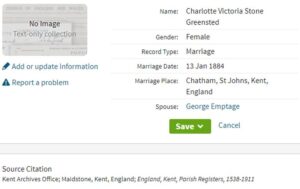
The best reason we have until we have access to the Maidstone Archives, is that it related to the fact that George’s mother was due to inherit a lot of property from her father George Stone’s estate. William owned the public house The Grapes, the shop next door, several houses in Chalkwell Road and properties in Rainham. William Stone’s will was very specific regarding the inheritance line, as he was not legally married to Charlotte’s mother (Mary Ann Greensted), and Mary Ann’s husband, William Greensted was still alive. The will records:
Be bequeathed “Unto Mary Ann Greensted who now lives with me for and during the term of her natural life and from and after her decease I give and bequeath the same together with all accumulations thereto unto my daughter Charlotte Victoria Stone to and for her own use and benefit but not to be subject or liable to the control of any husband she may marry.”
“And it is my Will and I hereby direct that William Greensted the husband of the said Mary Ann Greensted shall have no control over any of the property named in this my Will either real or personal. But shall be wholly barred from interfering in any way”
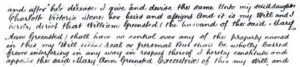
William Stone’s original Will was dated 18th February 1867, when Charlotte would have been only 4 years old; and the codicil was dated 21st May 1881, when Charlotte would have been only 18. Her father died in the June of 1881, and the estate would have been looked after by Charlotte’s mother. William Greensted died in 1892, in the October. Did Charlotte know he was dying and thought it was safe to marry the father of her children George Emptage on 12th March 1892 in a registry office in Sheppey? Had she already married him in secret in the eyes of the Lord at St John’s Chatham in 1884? We hope still to resolve this mystery, when access to the Maidstone Archives is possible.
We do know that Charlotte was also careful about the inheritance going to her children. Her Will was dated 6th May 1892, just a few months after she had formally married, and when George William Stone Emptage was 8 years old.
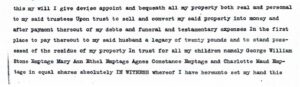
Clearly his mother was a woman of means, as her will left a healthy sum of £822 and 18 shillings in her estate in 1913, when she died, to divide between her four children.![]()
Why do newspapers and websites state George was Imbecilic, and was it True?
The 1891 census has a column to record if a householder was Deaf and Dumb, Blind or Lunatic, Imbecile or Idiot. Neither of the 1891 censuses that records George, show him as being imbecilic, and on his parents’ census records he was a ‘Scholar’.
In 1901 George with his parents and sisters were still living at 9, Chalkwell Road; George was aged 16, but no occupation is listed. We don’t know whether he was working and this was left blank, or whether George was not in work, as the family did have an income from various properties. But we know that by 1911 his three sisters had all married and left home. George and his parents were living at 16, Chalkwell Road, and George was a 26 year old General Labourer.
His mother, Charlotte died on the 7th of April 1913, aged 50. By this time George was 29 years old, living at 14, Lavers Cottage, Grovehurst, Milton Regis, where he was employed in the Kemsley Brickfields as a labourer. In 1915 his father married again, to Sara Beaufrere and his father moved to Welling Kent.
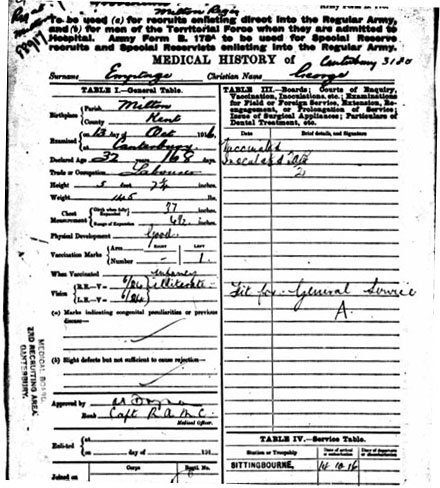
George was conscripted on the 13th October 1916 in Canterbury and enrolled into the 3rd Battalion of the Queen’s Regiment, service number 18998.
This shows George was single, 5 feet 7¼ inches tall, had blue eyes and dark hair and was 32 years and 168 days old. On his army medical he is said to be physically fit for general services and classified his fitness as being ‘A’ (able to march, see to shoot, hear well and stand active service conditions).
On the 12th of April 1917, after completing his basic training, George was assigned to the 29th Middlesex Regiment as Private 88971. On the 18th of May 1917 he was transferred to the 5th Labour Corps, as Private 152561.
Two months later on the 23rd July 1917, which was nine months after joining up (284 days), he was discharged on medical grounds by the army medical board at Colchester, Essex.
This was because now he was considered physically unfit for service. The records state his character was good and that his disability was classed as “imbecility (congenital)”, which was not due to his military service.
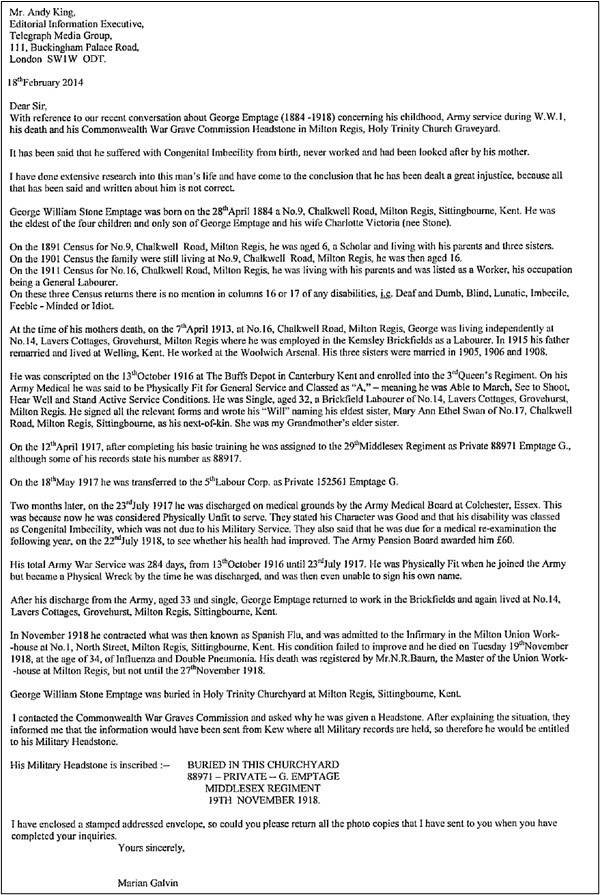
George’s abilities and label of “congenital imbecility”, has triggered much debate. Not least by his great niece Marian Galvin, who wrote to the Daily Telegraph newspaper in February 2014 (in response to a “Telegraph”, article by Claire Duffin), where Marian disputed the claim that George had never worked and his mother had always looked after him.
This resulted in the newspaper amending their article.
The Army fitness records show George was classified as being “A” in 1916, and also reveals that he could sign his name.
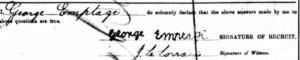
But something must have changed in George’s world, as by July 1917, when George was ‘discharged,’ in answer to the question “What is his present condition?”, the medical officer wrote:
‘Memory very deficient, cannot answer any of the questions left blank in this form. Sits all day doing nothing. Has never been able to earn his living, was always kept by his mother. Never in over a months observation has he had the initiative to speak to anyone.’ ‘He does not answer any questions but to this by Board, except [sic] that he lives at Sittingbourne, writes just 2 letters only as his name.’
We will never know what triggered George’s assessment and eventual discharge, but there are sufficient records to show he had not previously been recorded as Imbecilic. Also that the Army records are incorrect, as clearly he was not “always kept by his mother ”, as she had been dead for three years when he joined up, his sisters were all married and living at different addresses, and his father was living in Welling.
After his discharge from the army, aged 33, George returned to work in the Brickfields and again lived at 14 Lavers Cottage, Grovehurst, Milton Regis, Kent.
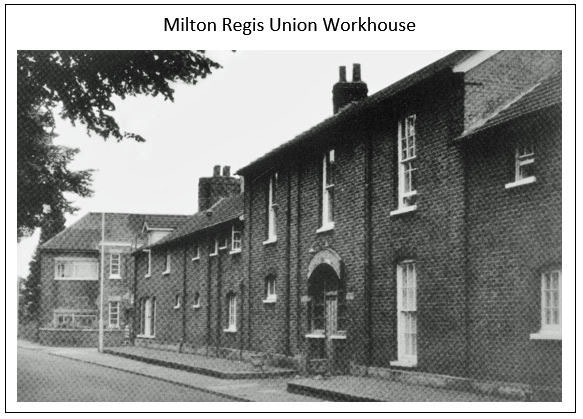
In November 1918 he contracted what was then known as ‘Spanish flu’ and was admitted into the infirmary at Milton Regis Union Workhouse at 1 North Street. His condition failed to improve and his death certificate shows he died on the 19th of November 1918 at the age of 35 (albeit he was 34) of influenza and double pneumonia.
Why is George not on a Milton Regis Memorial?
It is not as uncommon as you might think, for a man’s name to be omitted from a memorial.
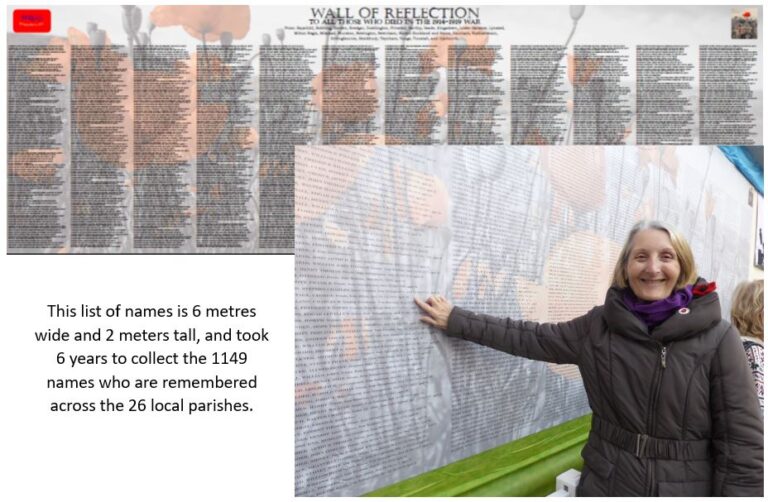
Of the 1,149 names we have on our Wall of Reflection (on display at the Heritage Hub in the Forum), which represents the 26 parishes in and around Sittingbourne, 269 were missed off the local memorials.
There are a plethora of reasons why they are missing: their family had died, moved away, didn’t want to be reminded that they had a loss, or maybe the criteria for adding names to a memorial by the individual groups didn’t meet with those stated at the time.
HRGS decided that anyone who was born, schooled, lived, loved or died in the parish, who died as part of the war effort should be remembered.
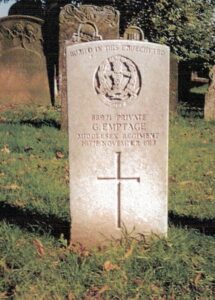
George was buried in the Holy Trinity Churchyard at Milton Regis and has a Commonwealth War Graves Commission headstone. Clearly the War Office recognised that George had played a part in the war.
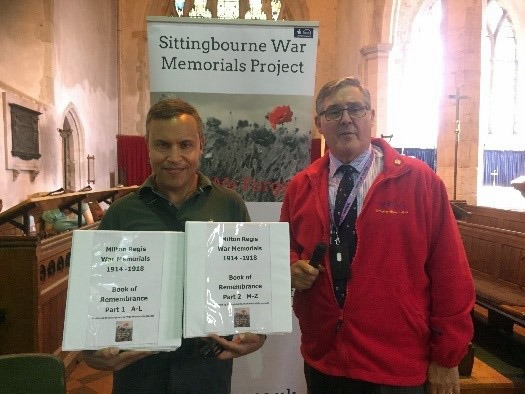
However, his name does not appear on any of the local memorials – except the Historical Research Group of Sittingbourne have added his name to the Milton Regis ‘Book of Remembrance’ that was presented to the church in September 2019, which includes all the local Milton men who died in the First World War; which is kept in the church and another copy at the Heritage Hub research room.
George is also remembered on the Wall of Reflection in the Heritage Hub, in The Forum Sittingbourne.
His great niece, Marian Galvin (pictured below), via George’s sister Agnes, attended the unveiling ceremony on 4th November 2018.
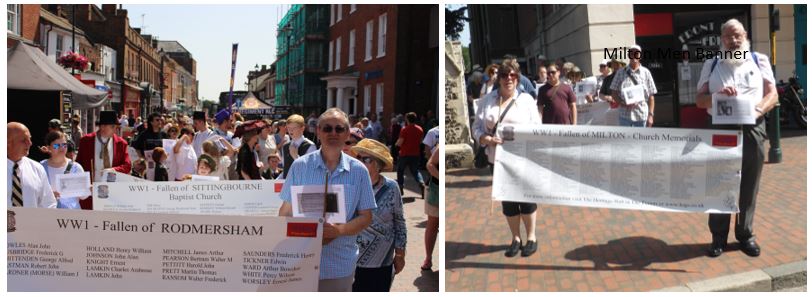
During the centenary of the First World War, George was commemorated locally by walking his name along Sittingbourne High Street on 29th June 2019, in celebration of the 100th anniversary of Peace Day, along with 1148 other local names remembered by the War Memorials project. His name appeared on the Milton banner, one of thirty six banners carried that day.
The evidence shows that George was prepared to represent his country and do his bit for the war effort, we therefore remember him.
We are proud to remember George William Stone EMPTAGE,
as we do all those who gave so much during the war.