Colonel Donald John Dean VC OBE
The Victoria Cross is the highest military decoration awarded for valour ‘in the face of the enemy’ to members of the armed forces, of any rank. It was introduced by Queen Victoria in January 1856, and since then only 1,358 have been awarded, 628 in the First World War.

Lieutenant Donald Dean was the grandson of George Hambrook Dean, and great grandson of George Smeed. He had been working for the family firm of Smeed Dean when in April 1915, as soon as he was eighteen, he enlisted in the 28th London (Artists Rifles) Regiment. He went to France in August 1915 and took part in the Ypres Salient and the Battle of the Somme. In October 1916 he was commissioned into the Royal West Kent Regiment, and fought at Vimy Ridge and around Givenchy. He was wounded four times during the war, in December 1916 and March 1917 at Ypres, in September 1917 during severe trench fighting and then again on the Somme by a Boche bomb.
After one incident the local paper printed a letter from Private Doway, who had also been wounded and was in hospital. It had been sent to Smeed Dean, and asked for the address of Second Lieutenant Dean, who had been in command of D Company, 11th Battalion of the Royal West Kent Regiment when he was injured. The letter said, ‘I am desirous of knowing the nature of his wounds. I was servant to Lieutenant Dean. He was a man I always admired and respected for his personal bravery and coolness under all conditions.’
The paper did not however provide information on his injuries or his experiences during the war. For details of those I am indebted to his own memoirs, edited by Terry Crowdy and published in the book ‘Donald Dean VC’.
His first injury was a minor one, in December 1916, when he got a small splinter from a whiz-bang (a small high-speed shell) in his right knee. The following March his injuries were more substantial. He said that under attack he ‘dropped smartly into a shell hole, breaking the ice and getting my legs down into the water, face against the ground and with my arms covering my head as far as possible, fingers laced at the back of my neck.’
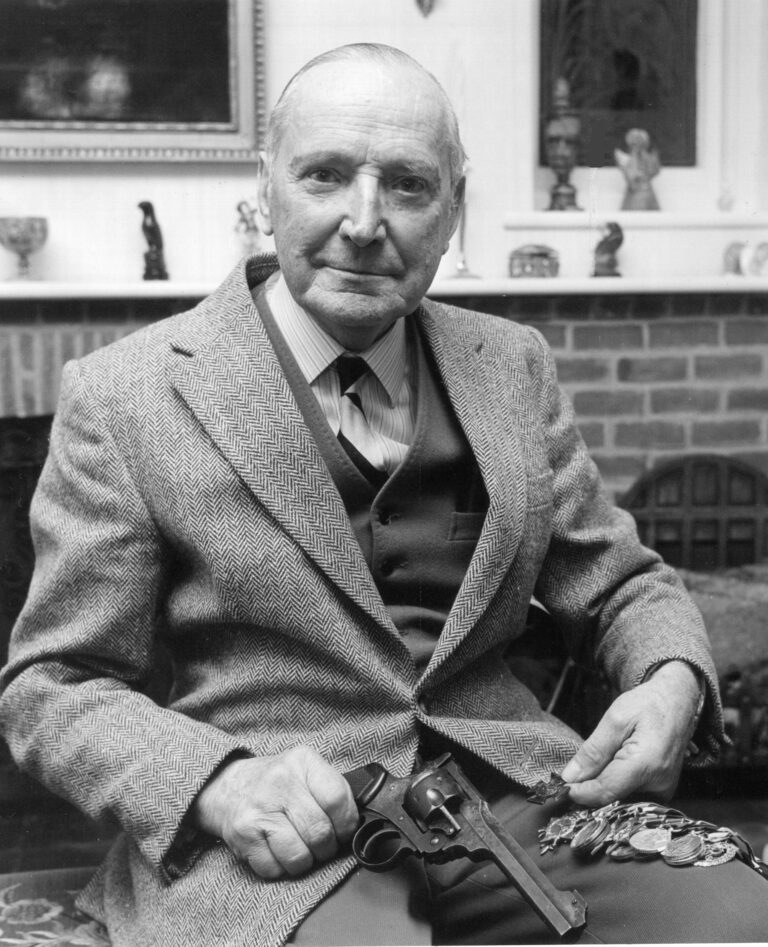
Colonel Dean in later life
‘This was just as well because one of the stick bombs burst under water and I got a small leg wound but another burst on the edge of the shell hole close to me and a large splinter penetrated my left forearm and cracked a bone, without the arm protection this would have been my head. A small splinter did, however, get through my interlaced fingers which partially broke the force before it entered the back of my neck.’ A visit to a hospital in Boulogne dealt with all of the injuries apart from the one in his neck, it was decided that it was too close to his spine to operate on and it wasn’t until six years later that it was removed.
In September 1917 he was hit in the left arm by hand grenade splinters, one of which went nine tenths through his forearm and stopped close to the skin on the other side, where it remained throughout his life! He also described how he ‘got in the way of a burst of machine gun fire and was hit by three bullets’, one of which passed through his purse, damaging the coins, and was stopped by his flask. He was taken to a dressing station where ‘the whole dugout was blown up and caved in. When I recovered consciousness I found myself completely buried and unable to move hand or foot. My steel helmet was partially over my face and I could just breathe.’ As he was being dug out they ‘found that my left leg was pinned by a piece of timber and while they were levering this up to free me the earth once more cascaded down and covered me again.’ When he regained consciousness he found that his jaw was dislocated and his nose was crooked.
His final, and worst, injuries came in October 1918, not long after the action for which he was awarded the Victoria Cross, and shortly before the end of the war. He was hit by shell splinters in both his right hip and his left thigh. He said ‘These were the most painful wounds I had sustained, as the shell splinters were so hot that they burnt me as they penetrated the hip and went a long way in.’ He finally got to England and was sent to the Cambridge Military Hospital. He recalled that he ‘had a bad time in hospital as my wounds turned sceptic, as was usually the case in those days. They operated several times to get the shell splinters out and even after that they opened one hole up and made another fresh one just to drain out what they were unable to drain from the original wounds.’
He was home on sick leave when he saw the news in the papers that he had been awarded the Victoria Cross, he never did receive any direct notification of the award.
The local paper reported on the incident for which he was awarded the Victoria Cross. It said that he was in a trench with sixteen men when fifty Germans attacked. He telephoned for assistance, but the Germans got into the trench. He, and a handful of young soldiers, attacked the enemy so fiercely that they drove them out, and he himself shot four of them.
The citation for the award said that it was, ‘For most conspicuous bravery, skilful command and devotion to duty during the period 24th to 26th September 1918, when holding, with his platoon, an advance post established in a newly-captured enemy trench north-west of Lens. The left flank of the position was insecure, and the post, when taken over on the night of the 24th September, was ill-prepared for defence. Shortly after the post was occupied the enemy attempted, without success, to recapture it. Under heavy machine-gun fire consolidation was continued, and after midnight another determined enemy attack was driven off. Throughout the night Lieutenant Dean worked unceasingly with his men, and about 6.00am on the 25th September a resolute enemy attack, supported by heavy shell and trench-mortar fire, developed. Again, owing to the masterly handling of his command, Lieutenant Dean repulsed the attack, causing heavy enemy casualties.
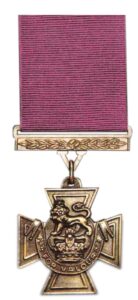
The Victoria Cross
Throughout the 25th and the night of the 25th / 26th September consolidation was continued under heavy fire, which culminated in intense artillery fire on the morning of the 26th, when the enemy again attacked and was finally repulsed with loss. Five times in all, thrice heavily, was this post attacked, and on each occasion the attack was driven back. Throughout the period Lieutenant Dean inspired his command with his own contempt of danger, and all fought with the greatest bravery. He set an example of valorous leadership and devotion to duty of the very highest order.’
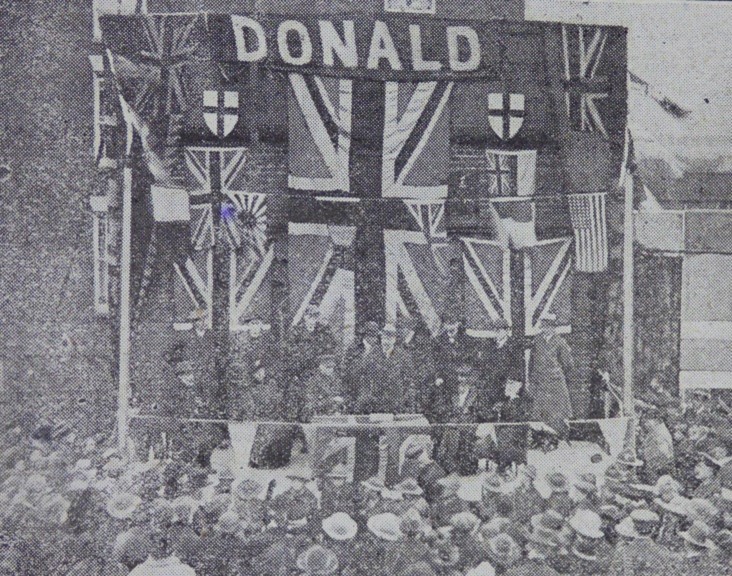
He was given his award by the King at Buckingham Palace on 15th February 1919. He returned to the town in the late afternoon, to be greeted by a huge crowd which had gathered in the Station Yard. A platform had been set up, at the back of which (covering the pumping station) was a large Union Jack, bunting and the name flag of the barge ‘Donald’. Councillors from the Sittingbourne and Milton Regis Town Councils, and the Milton Rural District Council were waiting, together with his aunt and uncle, Rev & Mrs Doubleday, and his cousin Leslie Doubleday. The band of the Queen’s Regiment played ‘See the Conquering Hero Come’, as he made his way, accompanied by his parents and grandfather, through the cheering crowd. The Chairman of Sittingbourne Council read a congratulatory address, which was presented to him – it would later be enclosed in a silver casket, but they hadn’t been able to get one in time. Then after the ceremony he and his family walked home.
The very modest 21 year old man was interviewed by a reporter of the East Kent Gazette. He described the action above and praised the bravery of his men and described, when during the attack on his position, the enemy managed to get into the other end of the trench. He personally shot four Germans and the platoon managed to push the rest back out of the trench. Donald had a telephone set up in his position. He called the field HQ and asked:- “They are shelling us rather badly. Can we get some retaliation? The shells seem to be coming from all directions” Then he suddenly broke off “The Germans are here! Good-bye.”
When the First World War ended he became the Officer Commanding 4th Battalion, The Buffs, and was based at Shornecliffe Camp. In 1930 he became a Major, and then took command of the 4th Buffs in 1936 as a Lieutenant Colonel. In the Second World War he was Officer Commanding No 5 Group Auxiliary Pioneer Corps. He took part in the defence of Boulogne in May 1940, and was reported as dead after he was blown up! His troop covered the withdrawal of The Guards; and he was one of the last soldiers to leave.
He served in Madagascar, a French controlled island in the Indian Ocean, which supported the Vichy French government. There were fears that it would become a base for German, Italian and Japanese ships. The Allies attacked in May 1942, and by that November the local governor surrendered. Lieutenant Colonel Dean was responsible for organising the return of the defeated Vichy forces to France.
He took part in the Sicilian Allied landings in 1943, and then served in Italy, being promoted to the rank of Colonel in 1945. During the war he was made a Companion of the Order of Dannebrog by the King of Denmark, which in that country is the equivalent of a British Knighthood.
Donald married Marjorie Wood at St Michael’s Church in 1923, and
they lived at Waldene, which he had inherited from his father. They had two
children, Michael and Susan; and several grandchildren.
He continued the family business of brick-making, and was a junior director of Smeed Dean & Co before the Second World War. He was the firm’s last director, and after the war started his own brick-making firm, Newington Brick.
He was awarded an OBE in 1961, and also became a Deputy Lieutenant of Kent. Locally he was a Justice of the Peace; President of the local British Legion, The Buffs and Horticultural Society; and an active Mason, being a Master of St Michael’s Lodge and founder of Saedingburna Lodge.
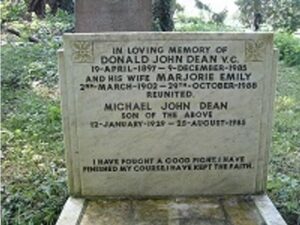
He died, aged 88, on 9th December 1985. By which time he was the oldest surviving VC from the First World War.
He was cremated in Charing; and his ashes were buried in a family grave in the churchyard of St John the Baptist Church in Tunstall. He had for many years served as a Churchwarden there.
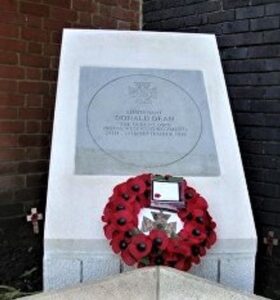
HRGS was instrumental in arranging for a special VC Plaque to commemorate him in Sittingbourne. It was unveiled on 9th November 2014; and his daughter, Susan, was one of those who attended the ceremony.
A poem published in the East Kent Gazette in 1919
BRAVO!
It was the brave Horatius,
First of the dauntless three,
Who we are told in days of old,
Did fight so gloriously.
That self-same valour, clear and bright
In all our lads we see.
The Nelson touch, ne’er saying much,
Like brave young Donald D.
For King and Country forth they went,
Scorning the battle’s noise.
Clean living ones ‘gainst filthy Huns
Fine stalwart khaki boys.
Time after time the Boches tried
To swarm that ruddy trench;
But, dogged grit just made them quit
The cost our heart-string wrench,
Our dear ones then sacrificed,
Their lives so worthily
Are now at rest among the blest
For all eternity.
All hail to thee! most gallant youth,
We’re proud as proud can be,
Public acclaim shall seal thy fame
Young Sittingbourne VC.